
- Lives in: Rio de Janeiro, Brasil
-
Learned from:
Mestre Cauã, Mestre Paulo Morfacto, Mestre Toni Vargas, Mestre Peixinho
- Capoeira Style: Contemporânea

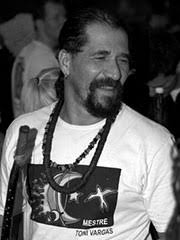
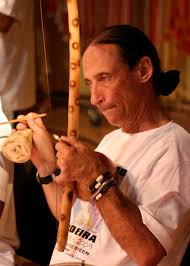
Biography:
José Luis Ramos, known in capoeira as Mestre Ramos, began his journey in capoeira at the age of 15, in the neighborhood of Olaria, Rio de Janeiro. His early formation took place under Mestre Cauã between 1973 and 1976, a period that grounded him in discipline and the fundamentals of the art. After the death of his first mestre, Ramos continued his training with Mestre Paulo Morfacto from 1976 to 1979, ensuring continuity in his development during a formative and challenging phase.
At the end of 1979, Mestre Ramos came into contact with the Grupo Senzala, one of the most influential movements in contemporary capoeira. He first trained with Mestre Toni Vargas, and later—following a pause in Toni Vargas’s work—continued his formation under Mestre Peixinho, a central figure in the Senzala lineage. Under Mestre Peixinho’s guidance, Ramos reached the rank of Corda Vermelha in 1990, the highest graduation within Grupo Senzala, marking his full recognition as a mestre.
In 1992, together with other mestres formed by Mestre Peixinho—among them Mestres Feijão, Abutre, Arruda, and others—Mestre Ramos co-founded the Centro Cultural Senzala de Capoeira, an institution that remains active to this day. The Center established itself as a reference point for capoeira rooted in ancestry, resistance, and social engagement, with its headquarters in Rio de Janeiro.
Since 1993, Mestre Ramos has maintained a long-standing social capoeira project in Bangu, in the West Zone of Rio de Janeiro, working primarily with peripheral communities. Through this initiative, he has consistently emphasized capoeira as a tool for cultural affirmation, social inclusion, and the transmission of Afro-Brazilian heritage. In parallel, he has coordinated capoeira centers across several Brazilian states—Minas Gerais, Cuiabá, Campinas, and Belém do Pará—as well as internationally in countries such as the United States, Italy, Spain, Ireland, and Slovenia.
Recognized internationally, Mestre Ramos is frequently invited as a special guest to capoeira events around the world, where he conducts workshops not only in capoeira, but also in Afro-Brazilian dances, samba de roda, percussion, and ritual practices connected to ancestral traditions. His teaching has reached academic spaces as well, including seminars and classes at institutions such as Princeton University and the University of Durham (North Carolina, USA).
In 2004, Mestre Ramos created and began coordinating one of the largest international capoeira gatherings: the Intercâmbio Cultural Roda Mundo Capoeira. Organized by the Centro Cultural Senzala, the event brings together influential mestres, groups, and practitioners from Brazil and abroad for days of rodas, workshops, lectures, music, and cultural exchange. Over the years, Roda Mundo Capoeira has become a major platform for dialogue, unity, and recognition within the global capoeira community.
Today, Mestre Ramos is widely respected as a mestre, cultural organizer, and agent of Afro-Brazilian popular culture. His trajectory reflects a commitment to capoeira not only as a martial art, but as a living expression of ancestry, resistance, solidarity, and collective identity—carried from the neighborhoods of Rio de Janeiro to the wider world.