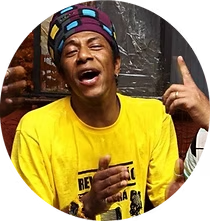
Mestre Pé de Chumbo
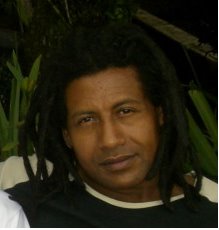
- Lives in: Germany
- Date of Birth: 08-Dec-1964
- Learned from: Mestre Joao Pequeno
- Capoeira Style: Angola
Biography:
Mestre Pé de Chumbo, born Gidalto Pereira Dias on December 8, 1964, in Floresta Azul, in the interior of Bahia, is one of the key figures responsible for spreading Capoeira Angola from Bahia to the state of São Paulo and later to several countries around the world. A direct disciple of Mestre João Pequeno, he is recognized for his serious, consistent work and for his loyalty to the lineage of Mestre Pastinha.
Born to João Pereira Dias and Erotildes Maria de Jesus, he was raised by his grandparents after the death of his mother during childbirth. His childhood was spent between Bahian towns such as Ibicaraí, Eunápolis, and Porto Seguro. It was in Ibicaraí, around 1974–1975, that he took his first steps in capoeira, encouraged by his older brother and motivated by a youthful challenge after losing a fight to another capoeirista. From that moment on, he never left capoeira.
At that time, he recalls, people didn’t distinguish clearly between “Angola” and “Regional”; it was simply capoeira, with a style and feeling very close to what is now recognized as Capoeira Angola. His formal relationship with Capoeira Angola as a defined style began in 1977, when he saw Mestres Dois de Ouro and Cebolinha performing in his city. They introduced themselves as angoleiros, playing a beautiful and efficient game that deeply impressed him and awakened his desire to seek out the Angola of Mestre Pastinha.
From Bahia to São Paulo – and Back to the Roots
Around 1980, as was common for many young people from the Northeast, he left Bahia to work in the state of São Paulo, moving to Indaiatuba, where his sisters lived. He worked in various companies and spent time in the city of São Paulo itself, where he frequented the famous roda at Praça da República.
In 1981, with the memory of the Angola game he had seen in 1977 still alive, he traveled to Salvador during his vacation specifically to look for Mestre Pastinha, whose name had been indicated to him by Dois de Ouro and Cebolinha. His ticket was marked for November 14, 1981, but Mestre Pastinha passed away on November 13, one day before his arrival.
With Pastinha gone, he began searching Salvador for Capoeira Angola and met Mestre Ezequiel, who directed him to Mestre João Pequeno. In 1982, Pé de Chumbo began his Angola formation under João Pequeno, training in the academy that carried Pastinha’s legacy. There, he also took classes with Mestre João Grande, deepening his understanding of Angola’s game, philosophy, and ritual.
Enchanted by the Angola of Pastinha and João Pequeno, he stayed in Salvador for a long period, dedicating himself to training. Later, he returned to São Paulo, but remained closely connected to his mestre, frequently traveling back to Salvador to continue learning.
Between Regional and Angola – Until the Definitive Choice
Back in São Paulo, in 1983 he founded the group Filhos de Bahia, where he worked with Capoeira Regional, which he had always practiced, and the Angola to which he had dedicated his recent years. He became professor of Capoeira Regional in 1987, without abandoning his Angola training with João Pequeno.
In 1988, as part of this constant exchange, he once again traveled to Salvador and returned to Indaiatuba accompanied by Mestre João Pequeno, who stayed for three months, teaching Capoeira Angola in his space. In 1989, Pé de Chumbo received the title of Mestre de Capoeira Regional and again brought João Pequeno to São Paulo.
In 1990, he made a decisive choice: he returned to Salvador determined to follow Capoeira Angola exclusively and voluntarily gave up his title as Mestre of Capoeira Regional. That year he spent a long period in Salvador, teaching at Mestre João Pequeno’s academy and fully dedicating himself to Angola. In 1991, he was graduated as Professor of Capoeira Angola by João Pequeno and once again organized an event in São Paulo with his mestre and other Angola names.
In 1992, he founded in São Paulo the Academia de Capoeira Angola João Pequeno e João Grande de Pastinha and was soon invited to teach in Sweden, starting a new phase of international work.
CECA and International Expansion
When he returned from Europe in 1993, he went to Salvador, where Mestre João Pequeno asked him to use his uniform and name — Academia João Pequeno de Pastinha / CECA (Centro Esportivo de Capoeira Angola) — recognizing Pé de Chumbo as part of the official continuation of Pastinha’s school.
In 1994, already fully dedicated to Capoeira Angola and to the work of Mestre João Pequeno, he was graduated Mestre de Capoeira Angola by João Pequeno, alongside other mestres such as Barba Branca, Jacaré, Junior Médico, and Jogo de Dentro.
From the 1980s onward, Mestre Pé de Chumbo became one of the main diffusers of Capoeira Angola in São Paulo, maintaining his Angola work since 1983 and organizing events that brought many Bahian angoleiros to the Southeast. Many of those who later formed their own Angola groups in São Paulo first came through these encounters.
Over the following decades, he built work in various Brazilian cities and in several countries, including Sweden, Germany, Portugal, the United States, Denmark, and Mexico. He helped establish multiple academies linked to the CECA lineage, carrying forward Mestre Pastinha’s name through the work of Mestre João Pequeno.
He is also the author and participant of important cultural works, such as the CD “Mestre Pé de Chumbo e Convidados” (2002) and the short film “Porto e Raiz” (2021), where he contributed narration, musical production, and acting.
Style and Legacy
Known for his low, grounded game, his seriousness, and his strong attachment to tradition, Mestre Pé de Chumbo is widely recognized as one of the great mestres of Capoeira Angola in the world. His trajectory shows a rare combination of technical excellence, respect for lineage, and a lifetime of dedication to the art and philosophy of Mestre Pastinha’s Angola.
Through his teaching, his travels, and his loyalty to Mestre João Pequeno, he helped ensure that the Angola game — once restricted mostly to Bahia — would take root in São Paulo and spread across Europe and the Americas, while remaining connected to its origins.