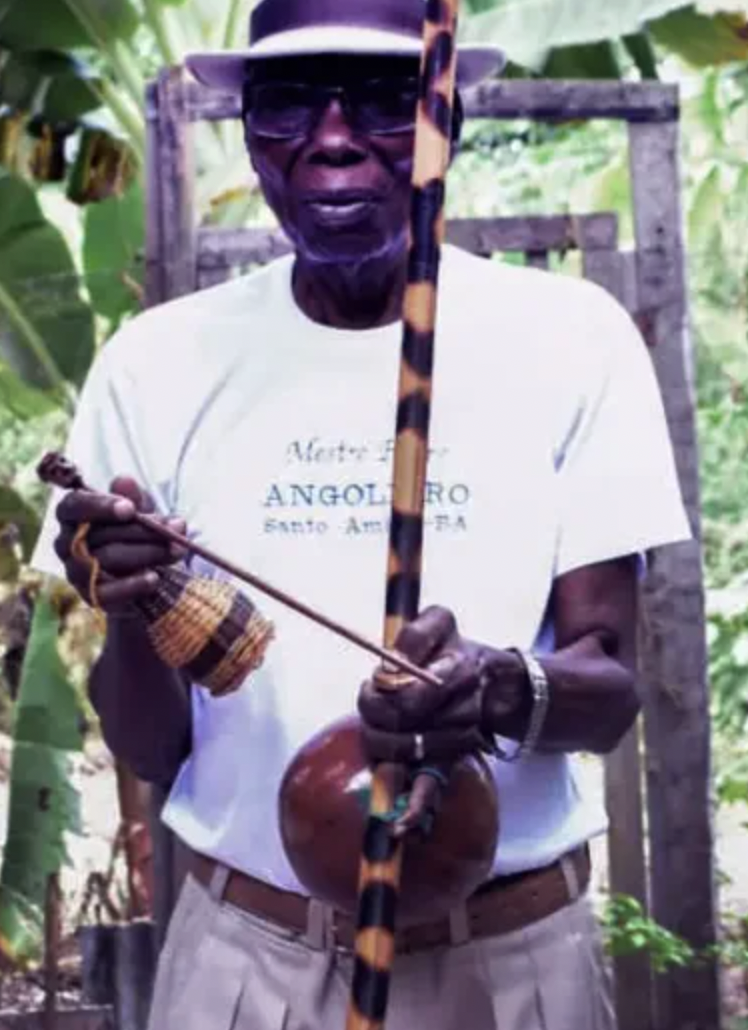
- Lives in: Brazil
- Date of Birth: 11-May-1927
- Learned from: Vivi de Popô, Mestre Arlindo
- Capoeira Style: Angola

Biography:
Mestre Felipe de Santo Amaro da Purificação, born Felipe Santiago on May 11, 1927, in the city of Santo Amaro, Bahia, stands as one of the most revered figures in the history of Capoeira. Recognized as the oldest living and still actively practicing Capoeira mestre, his life’s work embodies over seven decades of dedication to the art form that bridges body, rhythm, ancestry, and resistance.
Raised in the Pilar neighborhood of Santo Amaro, Felipe’s early years were shaped by both hardship and music. Orphaned at a young age, he found solace in the samba songs his father, Pedro Celestino dos Anjos, had once sung. This connection to rhythm and community led him to local samba circles, where he discovered his innate passion for the cultural expressions that would later define his life.
In 1945, his journey into Capoeira began under the guidance of Mestre Arlindo, an experienced angoleiro, and two years later, in 1947, he deepened his practice under Mestre Vivi de Popó, a key disciple of the legendary Mestre Popó do Maculelê. This apprenticeship not only refined his skills but also rooted him in the ancestral lineage of Capoeira Angola — one that emphasizes balance, humility, and the continuity of Afro-Brazilian tradition.
Throughout his long career, Mestre Felipe became a guardian of the oral and musical heritage of Capoeira. His voice and berimbau have been immortalized in several important recordings, including “Documento Sonoro do Folclore Brasileiro” (1988), “Salve Deus e Salve a Pátria” (2001), and “Vamos Vencer Camará” (2003). In 2004, he collaborated with Mestre Cláudio on the celebrated album “Angoleiros do Sertão e do Recôncavo,” a project that united generations through song and history. His most recent release, “O Que É do Homem o Bicho Não Come” (2020), stands as a poetic reflection on identity, humanity, and the enduring spirit of Capoeira.
More than a teacher or musician, Mestre Felipe represents a living archive of Afro-Brazilian history. His art, wisdom, and presence embody the resilience of a people who turned struggle into movement, rhythm, and celebration. Through his teachings, he continues to inspire practitioners across the world to honor Capoeira not merely as a martial art but as a vessel of memory and cultural survival.
His legacy — carried through countless students, rodas, and recordings — ensures that the flame of Capoeira’s ancestral knowledge will remain alive for generations to come.