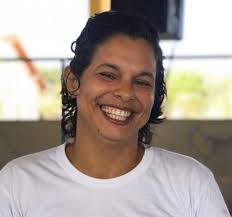
- Lives in: Salvador
- Learned from: Mestre João Pequeno
- Capoeira Style: Angola
Biography:
Cristiane Santos Miranda, better known in capoeira circles as Nani de João Pequeno, has been involved in Capoeira Angola since childhood, partly because she is the granddaughter of João Pereira dos Santos, the late Mestre João Pequeno de Pastinha, who taught her Capoeira Angola and entrusted her with the mission of continuing his teachings, inherited from the philosophy of his master, Vicente Ferreira Pastinha, or simply Mestre Pastinha. As she was raised by her grandparents, along with her two brothers, her grandfather initially insisted that her brothers accompany him in capoeira and allowed his granddaughter to decide when she wanted to start, but only when she wanted to. However, 23 years ago, she decided to start her life in this art, and soon her brothers, who were already well known, for whom the master even wrote songs, one of which was "Ho Bujão... Capoeira de Angola é Rolada no Chão" (Ho Bujão... Capoeira de Angola is Rolled on the Ground), soon stopped practicing capoeira. The master tried again, but to this day, only Nani has continued the family legacy. Since then, the master has been teaching classes at the CECA academy (Capoeira Angola Sports Center) in Salvador, Bahia (at Fazenda Coutos and Forte do Santo Antônio), as well as on trips, in group projects, and in schools. In 2006, she was recognized as a capoeira Angola teacher and thus began teaching in projects and within school spaces. In 2018, she was classified as a Master of Capoeira Angola by her godfathers, Mestre Ciro and Mestre Roberval. She has experience in berimbau making, social projects, children's recreation through Capoeira Angola, and the rhythms and sounds of Capoeira Angola (musicality and samba de roda). In addition to capoeira, in 2013 I had the opportunity to complete a degree in Physical Education at the Social Faculty of Bahia, thus expanding my knowledge of popular culture through education and bringing my experiences to children, young people, and adults in schools and disadvantaged communities.