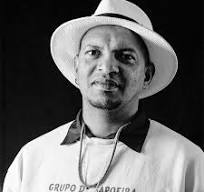
- Lives in: Berlin, Germany
- Date of Birth: 23-Sep-1966
- Learned from: Mestre Moraes, Mestre Caiçara
- Capoeira Style: Angola
Biography:
Mestre Laércio discovered capoeira in the bush. In 1976, at the age of 10, he used to play Indian and hunt birds near where he lived, in Fazenda Grande do Retiro, in the marshland. It was during one of these games that his friend Samuel showed him the way to Mestre Caiçara's academy in the São Caetano neighborhood.
Laércio already knew capoeira, brought up by his father, Gilberto Domingos Borges, who was born in Santo Amaro. He didn't practice the art, but he had a lot of fun watching the rodas and the capoeiristas' mischief, and sometimes he took Laércio to see them.
Despite this, Seu Gilberto didn't want to see his son getting involved with capoeira and, seeing his son's growing interest, tried to dissuade him from practicing capoeira by enrolling him in a karate academy.
So Laércio took advantage of his kimono pants and went to train in hiding at Mestre Caiçara's academy. To get there he would cross the woods at six o'clock in the afternoon, sometimes having to return late at night and pretend to have been playing with his friends in the street where he lived.
Thus began Laércio's intense contact with the great mestres who contributed most to capoeira at that time, such as Mestre Caiçara, Canjiquinha, Valdemar, Curió, Fernandinho, Boca Rica, Zacarias, João Grande, João Pequeno, Papo Amarelo, Bola Sete, Bóbó and others.
Later, after Mestre Pastinha's death, Laércio went to live in the Quinta das Beatas neighborhood, now Cosme de Farias, where he met Roberval. At this time Laércio was attending Mestre Caiçara's academy. Mestre Caiçara no longer ran the training sessions, which were held on the slab of his house, where he couldn't go upstairs, leaving that responsibility to his son Toinho, who often didn't show up. So Laércio, who was developing quickly in capoeira, began to do some training at Mestre Caiçara's academy, under his guidance.
Laércio met Roberval at a roda held at the D. João Pedro dos Santos school. Part of a recreational program that this school ran, along with volleyball, soccer and other activities, every Friday there was a capoeira roda attended by Mestre Celeste, Manoel Rezendo (a student of Mestre Bimba), Mestre Alfredo's students, among others.
Later, in 1984, in a conversation with Roberval and Cabore, they decided to found a group to rescue, maintain and preserve the roots of Capoeira Angola. They created a group named Filhos de Angola after Mestre Pastinha, because they considered him to be the father of Capoeira Angola.
The Filhos de Angola spent three years with Mestre João Pequeno, two years with Mestre Canjiquinha, a long time with Mestre Boca Rica and had the opportunity to attend classes with Mestre João Grande on Sundays at Forte Santo Antonio, in the GCAP space.
When Mestre Moraes returned from Rio de Janeiro, together with Mestre Cobra Mansa, at a time when Capoeira Angola was at risk of extinction, the Capoeira Filhos de Angola Group (GCFA) was invited by Mestre Cobra Mansa to join GCAP, in a joint effort to strengthen Capoeira Angola in Salvador. With Mestre Moraes, the GCFA learned the cultural and musical value of the roots of Capoeira Angola.
After a while, the GCFA felt the need to have its own space and started sharing a room at Forte Santo Antonio with Mestre Boca Rica. They shared this room for two years.
Then, continuing with the objective of preserving, maintaining and valuing the roots of Capoeira Angola, Laércio began working with underprivileged children on the outskirts of Salvador.
As a result of this work developed with Marrom in the Brotas neighborhood over three years, the Acupe group emerged, linked to the GCFA.
Fighting for the dignity of Capoeira Angola, Laercio and Roberval, together with mestres Curio, Bom Cabrito, Cabore, Baixinho, Augusto, among others, came up with the idea of founding the ABCA - Associação Brasileira de Capoeira Angola and the Casa da Capoeira Angola in Salvador. Once created, the ABCA was coordinated by a council of mestres such as Curio, Gildo Alfinete, Mala, Pele da Bomba, João Pequeno, Dez de Ouro, Bom Cabrito, among others.
In September 1993 Laercio moved to Europe with the aim of promoting Capoeira Angola. At the beginning of his work in Europe, he took part in various workshops with Mestre Rogerio, Mestre Sapo and Rosalvo. At that time, Capoeira Regional was very widespread in Europe and it was necessary to inform new capoeiristas about the real Capoeira, Capoeira Angola, where all the rituals brought by Africans to Brazil are present.
Over time, seeing the willpower of people interested in capoeira in Europe, sometimes trying to learn on their own, attending workshops, looking for information, always going to Salvador in Brazil and so on, Laércio began to work with nuclei in different countries with the aim of guiding these capoeiristas. This is how the GCFA nuclei emerged in Europe, and they have been flourishing ever since. There are currently GCFA nuclei in England, Sweden, Spain, France, Switzerland and elsewhere, with mestres, contramestres and trainers/teachers trained by Laércio, who lead these groups under his guidance.
Laércio visits each group periodically and continues his work in Berlin, Germany, where he currently lives.
Watch Master play: