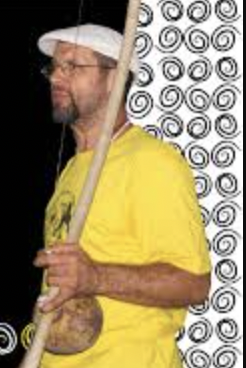
- Lives in: Rio de Janeiro, Brasil
- Learned from: Mestre Marco Aurélio, Mestre Moraes
- Capoeira Style: Angola
Biography:
Armando Teixeira Leão, widely known as Mestre Armando or Mestre Armandinho, is one of the important figures in the history of Capoeira Angola in Rio de Janeiro and in Fortaleza, Ceará, with a career that spans from the 1970s to the present day.
Early Training and Formation in Rio de Janeiro
Mestre Armando began practicing capoeira in 1974 with Mestre Marco Aurélio in Rio de Janeiro. Shortly after, he became a direct student of Mestre Moraes, leader of the Rio-based revival of Capoeira Angola and founder of GCAP (Grupo de Capoeira Angola Pelourinho).
He was part of one of the strongest and most influential generations of Angoleiros in Rio, alongside several young practitioners who helped re-establish Capoeira Angola’s identity during a period marked by the Black Consciousness movement and Afro-Brazilian cultural activism.
During this time, Armando:
-
became well known in the rodas of Rio,
-
taught many students who would later become central figures in the Angola scene,
-
and participated actively in cultural and political spaces connected to the struggle for racial awareness and Black identity.
Through capoeira, he developed a strong connection to Brazil’s Black movement and began taking part in social and political initiatives aimed at defending Afro-Brazilian heritage.
Move to Fortaleza and Social Engagement (1990s)
In the 1990s, Mestre Armando relocated to Fortaleza, in the state of Ceará. There, he founded a Capoeira Angola group and became involved in multiple Afro-Brazilian cultural and social movements.
His work included collaborations with:
-
local NGOs,
-
community-based cultural organizations,
-
projects supporting racial equality and Afro-Brazilian identity.
In Fortaleza, Armando quickly became known for his connection to key Black and African-descendant social movements, reinforcing the cultural and political dimensions of Capoeira Angola.
Connection to GCAP and Later Independence
From 2001 to 2008, his group in Fortaleza was officially affiliated with GCAP, maintaining direct ties to the lineage of Mestre Moraes.
In 2008, the group became independent, continuing to work with the same cultural and historical principles while strengthening its own identity in Ceará.
Current Work
Today, Mestre Armando works as an Executive Coordinator for Racial Equality Policies, continuing his long trajectory of advocacy for the rights, visibility, and cultural heritage of Afro-Brazilian communities.
His capoeira work remains deeply connected to activism, education, and the defense of African cultural traditions in northeastern Brazil.
International Engagement
Although widely respected within Brazil, especially among practitioners connected to Mestre Moraes and GCAP, Mestre Armando has made few appearances abroad.
Workshops with him are considered rare opportunities to learn from a mestre directly tied to the early Angola movement in Rio.
He has expressed preference for small, focused, and intimate workshops, emphasizing close study and personal interaction rather than large public events.
Legacy
Mestre Armando is recognized for:
-
being part of the first generation of Angoleiros formed in Rio under Mestre Moraes,
-
maintaining Capoeira Angola in Ceará for decades,
-
linking capoeira practice to Afro-Brazilian political and cultural movements,
-
forming numerous students and strengthening community-based work,
-
and contributing to racial equality and African-diaspora cultural policy.
His influence is felt both in Rio’s historical rodas and in the strong Capoeira Angola presence in the northeast, particularly in Fortaleza.